Thursday, June 05, 2014

The Growth of Clary Sage

Clary is a Unique Sage in my Garden


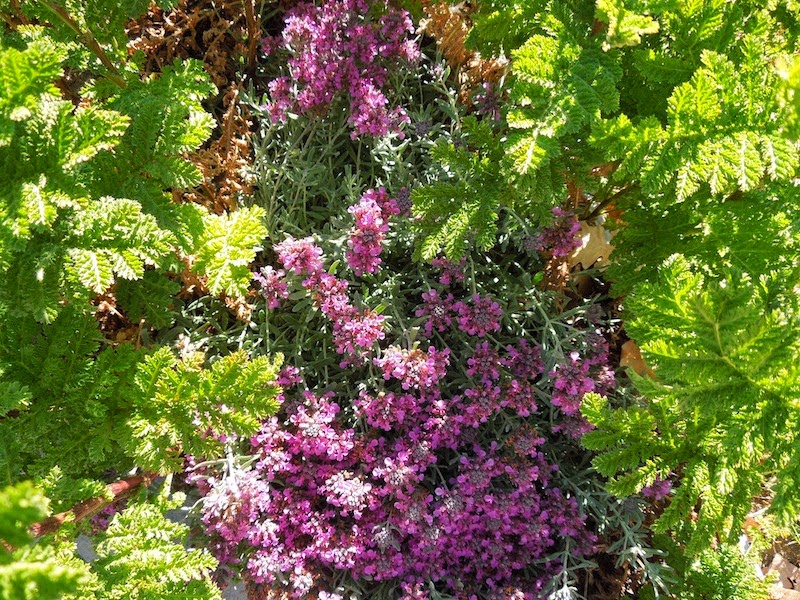
Clary sage (Slavia Schlerea) is quite different from the other other sages I grow. I had no idea to expect when I planted it. It's lush flower spikes surprised me. Best known historically as a remedy for getting foreign matter out of one's eyes with its seeds, it also can be used in the kitchen, but is not as versatile there as the other sages are. Pregnant woman should avoid it, and no one should mix it with alcohol.   I only grow clary sage to add beauty to my summer garden. 


The Growth of Clary Sage
Clary Sage Bud, May 25

My Experience with Clary Sage in the Garden


I first planted my clary in a pot in my yard in Templeton. A couple of years ago I brought the pot to our Paso Robles home. It bloomed there last year. Then it appeared to die down and I thought it was gone. I've since learned it can be biennial (blooming the second year and then dying) or perennial. 

After this year's rains, it came back and started to grow again. On May 25, I snapped the photo of its first bud of the season, which you see above.


Within a week, the buds had turned into the flower spikes you see to the right. The plant is still in the original pot. I am hoping it will reseed. It reseeded once three years ago, but the weed abatement man thought it was a weed and dug it up. He tried a day later to pot it, but the roots had been exposed too long to make a recovery.


The Growth of Clary Sage
Clary Sage in Bloom, Early June


Other Sages I Grow


I also grow tricolor sage, to the left in the photo above. I can't recall if I ever saw it bloom. Most sages bloom in June, but so far I've never seen so much as a blossom on this potted plant. I have seen the more established plants in Templeton bloom. I made this greeting card on Zazzle with it pictured in bloom next to common sage. 


It could be the tricolor variety is on a different timetable than other sage varieties, in spite of what the books say. The Missouri Botanical Garden website says tricolor sage should bloom in May or June. The flowers are supposed to be lavender or purple and quite showy. They should be hard to miss. Maybe tricolor sage has different blooming dates in Missouri. 

My common sage, pictured below, has been blooming since at least April in my Templeton herb garden as has been my black sage in both gardens. My watermelon and Spanish sages have also been in bloom since at least May. You can see them, in addition to the black sage, pictured in my post on what blooms at the end of May


The Growth of Clary Sage
Common Sage in Neglected Herb Garden, © B. Radisavljevic

Have you ever grown clary sage? If not, would you like to? What is your favorite variety of sage?  Please feel free to leave your feedback in the comment box below the share buttons. 

Tuesday, June 03, 2014

Monarda Didyma (Bee Balm) Is Blooming

I planted this mother monarda didyma plant last year on June 14.  It stayed mostly low to the ground, competing for space with all the gazanias surrounding it. I had to dig out a clearing in the middle of the gazanias. You can see the monarda (bee balm) freshly planted there near the center of the photo. That was a good year for gazanias, which bloom yellow, but they don't bloom as much in this partial shade as they do in full sun all day. 

I planted the bee balm here because I wanted its red flowers to contrast with the green and yellow around it. It took the monarda longer to bloom that first year. The flowers were few. Maybe all that competition from the gazanias hurt it, and I had planted it later than I should have. In the photo below you can see how it looked in its surroundings when it did bloom. The photo was taken in the middle of August. The bee balm flower is the one rising in back over the other flowers. The photo is a bit over exposed so the red color is faint. The flowers in front are opal basil, borage, catmint (in the pot), African basil, and calendula. 


During our very cold winter, most of the gazanias died back, as did all the basils, leaving less competition. In the early spring.  I thought the monarda had died, too. I didn't see it anywhere. I thought this was a perennial plant, but I've never had it last more than one year.

This spring, several monarda plants sprung up in a row. The mother plant must have reseeded itself. I saw the first bud on May 25. See it in the photo to the right? I took the photo from the back of the flower bed looking out toward the dying lawn. 

To the right of the foreground is my mullein, with the very large leaves, which I planted last year. It's a biennial which should bloom this year. I think it was attacked by a tomato hornworm I found on a borage plant in this flower bed. I have the snails under control.


You can see the row of blooming monardas below. They almost appear to be dancing. Some of the gazanias in back are reviving, but not enough to give my bee balm much competition. I hope my bee balm reseeds again next year. I would like to have an entire clump back there next June. 


I grow monarda primarily for its ornamental value. I'm also hoping it will attract hummingbirds and bees as it is supposed to.  My Rodale's Illustrated Encyclopedia of Herbs  tells me bee balm flowers are also tasty in salads and the leaves are good for tea. I just may experiment with the culinary uses of monarda this year. 

Have you ever grown monarda? If so, it it meet your expectations? Have you used it in the kitchen or for medical conditions? I'd love to have you share your experiences. 

Saturday, May 31, 2014

What Blooms in My Paso Robles Garden at the End Of May: Herbs

Herbs are an important part of my garden plan. They feed the bees and butterflies, and they also contribute color to supplement that provided by the flowers. Many of the herbs, including the borage and the hyssop, are pictured mixed with the flowers in my previous post,  What Blooms in My Paso Robles Garden at the End of May: Flowers. Pictured at the left is Spanish sage, surrounded by star jasmine. I planted the Spanish sage last year about this time. 

I divided the santolina you see below from a plant I have in Templeton. I love the yellow color, but the Templeton mother plant sprawls. I had this in a pot, so I moved it pot and all into my flower bed closest to the house, near the back. The gray foliage contrasts well with the green leaves of other plants and the yellow of its own button flowers. 


A plant that was new to me last year was salvia microphylla, also known as wild watermelon sage. It is drought-resistant. I expect it will continue to spread and grow taller, as I intended. I am trying to fill my dry side yard with larger shrubby herbs that will spread to choke out weeds while providing color during every season. Below is my watermelon sage. The blossoms are small, but they do contribute color.


Many sages seem to bloom at this time of year. My common sage is blooming in Templeton, but I haven't planted any of it here in Paso Robles. I did divide my black sage plant there and I planted the division in my side bed here. The mother plant is huge -- about six feet tall and just as wide in all directions. So far it's still small here. I plan to keep it under control. It is not especially colorful with its tiny whorls of pale lavender flowers, but it's always covered with bees when in bloom. See the flowers below.

Black Sage on May 27

I planted the red velvet yarrow below in a pot to keep it from spreading, since I've heard it can be invasive. I think it's outgrowing the pot, though, and it's getting leggy.  I think in fall I will divide it and plant it near the tansy in the front corner of the side yard. It does well under dry conditions. 

.
Red Velvet Yarrow in Pot


As I write this, my monarda and clary sage have buds and will soon be in bloom. I will be sharing those photos soon.

Wednesday, May 28, 2014

What Blooms in My Paso Robles Garden at the End of May: Flowers


May is a colorful month in the garden. I have decided to start keeping a record of what blooms each month so that I can predict what my garden will look like every month of the year. My goal is to have some  garden color through all seasons. I took this photo on May 27, 2014. Not all colors come from flowers.

In the foreground you can see the mums which started to bloom a couple of weeks ago. If you look back a bit and to the right, you will see a pot of tricolor sage that adds a touch of purple to the mix. Next to it is a hyssop plant with its tiny blue flowers to feed the bees. The yellow is calendula, and that blooms almost all year and reseeds itself. As you can see, I like to mix plants up in my garden, so it has a somewhat wild look. Now we will take a closer look at individual flowers.

First are the chrysanthemums. I usually associate them with autumn, but these are also blooming for me in spring. I just read that I can take cuttings from these up until the end of the month. I might try it to see if I can make more plants by fall. I have two regular size mums and two miniature ones of different colors spread throughout this garden now. 


Pansies have been special to me since I was a child. My grandmother used to have them planted around her fruit trees in small circular beds. These were planted last fall, and I don't expect they will last much longer as the days get hotter. I'm glad they are still blooming in late May. 

I also planted some petunias in the fall. Most have faded and died, but this pink one still remains. These are technically perennials, but people usually grow them as annuals.  I may not replace them, since they don't do well without more water than I want to give them since water for landscaping is rationed until the end of summer. This petunia is taking cover under an iris leaf. 


Carnations have always had a special place in my gardens because my mother loved them. I still have some carnation plants that came from root divisions of one of her plants. I first started one in our Newbury Park home in Ventura County, and when we moved, I brought it here. I have two babies from that mother plant in my Paso Robles garden now. They produce very light pink flowers. You can see one of those plants below. Although I have been deadheading them, they appear not to be producing many new flowers now, so I think their season may be coming to an end. They have been covered with flowers for the past two months. Now each plant only has a flower or two left.


Since I have long wanted a more colorful carnation, I could not resist this two-tone dark pink with purple Chomley Farran carnation. (See below.) It is not only deeper in color, but the purple markings make it more striking. It seems I planted it too far back in the bed, though,  and the flower stems are much too long as they reach out toward the sun. 

As you can see, in order to keep the flowers from landing on the ground, I've propped them up on some borage plants -- also in bloom with tiny star-like blue flowers. On the far right you can see a single yellow calendula. 


In this next photo I have also mixed the flowers with herbs. I wanted some drought resistant plants in a side bed in a corner between two sidewalks. It has poor soil and doesn't get much water. I decided to plant a Fruity Teucrium there, with a tansy plant on either side of it. I expected the tansy to contrast with the purple flowers of the Teucrium, since the tansy will bloom yellow when it finally blooms. I know tansy spreads, but I didn't expect it to be so much taller than the Teucrium to the extent that it almost blocks it from the light. I will have to cut it back if the Teucrium is to survive. 


Fruity Teucrium Surrounded by Tansy
Another plant I bought new last year was the butterfly blue scabiosa you see here. It's also known as the pincushion flower. I would like to find more of them, and I may plant more from seed, but I think I want deeper and brighter colors if I add more plants. The small blue flowers you see on the right side are from the hyssop plant that shares a border with the scabiosa. 

This is Lamb's Ear. The mother plant came from my Templeton house, where I kept it in a pot because the gophers liked to eat it when it was in the ground. I have terrible gopher problems there, so I always keep the mother plant of anything new in a pot until I see if the gophers like it. Since Lamb's Ear really spreads to the point of being invasive and needs little care, I like to use it where I want to fill in bare ground to suppress the growth of weeds. I love the fuzzy gray Lamb's Ear leaves, and at this time of year the pale  flower stalks shoot up and fill with tiny lavender flowers. If you look carefully, you will see the bees love them. 


Last in this post I will show you my star jasmine which started blooming in May and which I expect to keep blooming all summer. It's attractive in moderation, but it tends to want to bury my border plants and I have to keep it well-trimmed. It does provide a nice background for contrast with the calendula, sage, pansies, godetias, lilies of the Nile, and poppies which I planted in front of it near the sidewalk.

The Flanders poppies also bloomed at the end of May as you saw in my last post. 

In my next post I will introduce the herbs that are currently blooming. Please stay tuned.

Monday, May 26, 2014

In Flanders Fields the Poppies Blow


Poppies for Memorial Day


Just before Memorial Day is a fitting time of year for my Flanders Poppy to bloom. They were blooming when the poem "In Flanders Fields the Poppies Blow" was written by John McCrae during World War 1 on May 3, 1915. He had just officiated at the funeral of a fellow soldier and friend who had died in  the Second Battle of Ypres. He had noticed that fields of these red poppies quickly spang up around the graves of those who had died in Ypres.


In Flanders Fields the Poppies Blow

Flanders Red Poppies, © B. Radisavljevic


In Flanders Fields


In Flanders fields the poppies blow
Between the crosses, row on row,
   That mark our place; and in the sky
   The larks, still bravely singing, fly
Scarce heard amid the guns below.

We are the Dead. Short days ago
We lived, felt dawn, saw sunset glow,
   Loved and were loved, and now we lie
         In Flanders fields.

Take up our quarrel with the foe:
To you from failing hands we throw
   The torch; be yours to hold it high.
   If ye break faith with us who die
We shall not sleep, though poppies grow
         In Flanders fields.


The battle itself had been a gut-wrenching experience. McCrae described it as a nightmare that lasted for seventeen days and nights filled with the sights, sounds, and smells of the warfare itself and the wounded, dead, and dying. Most of us can't even imagine the horror of this assault on their senses, and the emotional impact of seeing your friends die around you and wondering if you would be next.


We Must Not Forget Those Who Sacrificed for Our Freedom 


 Although McCrae describes this particular battle, these experiences would be very similar to what hundreds of thousands of war veterans and those still in harm's way could describe more graphically if they wanted to, but most would prefer to forget them. We must not. Those who laid their lives on the line to protect the freedom we enjoy in America, Canada, the United Kingdom, and the rest of free Europe deserve to have their sacrifices remembered. 

Those who survived battle and are still among us have memories most of us would never want to live with. Many veterans are reluctant to speak of the war experiences that they will never be able to completely put behind them. What they did has allowed the rest of us who have not experienced these horrors to live unburdened by the memory of them. We can never repay our debt to them. But we can speak up and insist our government keep its promises to them for timely and competent medical care. 


We cannot do anything for those who gave all they had, except to remember them and fight as citizens to preserve the freedom they died for. But we can thank those who have survived the battles and carry physical or mental scars. Why not send a veteran you know a note and thank him or her for the part of his or her life given in service. 


Information on John McCrae come from Wikipedia.


Note: I was surprised to see the poppy in the introductory photo  spring up in one of my flower beds. I may have planted some seeds there, but if so, I have forgotten them. Later I found the seedling next to my Sweet Williams -- just one seedling.  I was delighted. I'm going to keep the flowers picked so I can keep this blooming as long as possible. When it looks like the end is near, I'll let the plant reseed. I'd love to fill my empty spaces with these next year. 

Sunday, May 25, 2014

How My Garden Has Progressed in Two Years Since 2012


First Ladybug I've Seen This Year on Catmint Plant
I'm back in the garden now.This morning was typical because it held a surprise for me -- this first ladybug I've seen this year. Something new is always happening in my garden, but I only know if I keep my eyes open for it.  I keep my camera handy to record anything I want to remember.

2012 and early 2013 were not good gardening years for me. I was caught up in freelance writing on Squidoo and HubPages, and I was also building up my Zazzle stores. I simply did not have time to do much gardening. I had inherited a house from my mother in Paso Robles, California in 2006 and in 2013 I decided I had to do something with the front yard there. My mother had done nothing with it in the almost ten years she lived there, and there were a few green shrubs and not much else.

The city of Paso Robles was getting stricter about water rationing in landscaping, so I knew if I were going to makeover the garden, I'd better use drought resistant plants.  I began my project just about this time in 2013. By then I had started writing for Bubblews, so I started a Garden Journal there. Every time I did something new to my garden or when changes such as a plant starting to bloom for the first time occurred,  I reported it, with photos, in a Garden Journal post. Unfortunately Bubblews removed almost all the photos from our posts in a big update to the site, and last year Bubblews quit. Except for my written back-ups and saved photos in a different place, all those visual journal posts are gone. From now on, I'll be keeping my gardening journal here again.


Is that garden now a showpiece? Definitely not. It will always be a work in progress and there will always be surprises. I write about it because I know there are many hobby gardeners like me who like to get ideas from ordinary gardeners like themselves and see what works and what doesn't in other gardens. I have learned new techniques and gotten many hints from those who have commented on my gardening posts at Bubblews. But now I want to bring some of those gardening posts back here to Blogger.

I have two garden areas -- one in Templeton, California, and one in Paso Robles. Both are very close to being in Sunset's Zone 16 (USDA Zone 9). We have hot dry summers, and sometimes have temperatures in the triple digits in May or October.  Our winters normally have lows ranging from 25 degrees down to 17 degrees F but a couple of the last twenty winters had temperatures down to 12 degrees F. This was cold enough to kill almost everything above ground on my gazanias. Fortunately, they regrew when temperatures warmed up again. Our summers are hot and dry in the daytime, but usually cool down when the sun sets.

Grapes and oak trees flourish here, so the Paso Robles and Templeton Gap areas are home to many vineyards. Olive trees also do well. Drought resistant public plantings include a lot of lavender, yarrow, artemisia, sages, rosemary. and santolina. I have grown all of these, and once established, they need little care. I find I can learn a lot about what to plant by seeing what the businesses use in their drought-resistant landscapes.

Flowers that work well for me year after year include irises, calendula, and daffodils. These are also plants that gophers tend to stay away from. Herbs also work well in my gardens and add summer color. The photo above shows the first ladybug I've seen all year nestled in my catmint, which grows in a pot in my flower bed closest to the house. It will be blooming soon. I also grow oregano, thyme, basil, cilantro, catmint, spearmint, sages, clary sage, mullein, monarda, borage,  hyssop, wormwood, rue, tansy, parsley.

So far my pansies I planted in winter and the petunias I planted last year are still blooming. That surprised me, since they usually don't last so long. My hyssop started to bloom about a week ago. So did my Chomley Farren carnations. They are a deep pink with lavender markings. I will try to show you the photos in future posts.

Spanish sage in bloom April 25, 2014, next to yellow pansies. Lamb's ear is in front of pansies. Godetia is just starting to bloom in foreground. Back right is rue next to a volunteer gopher plant. Behind all is jasmine.


My Spanish lavender blooms are dying down now after blooming last month. My Spanish sage is still going, though my jasmine, which is starting to spread and bloom is trying to bury it. I need to give that jasmine a haircut. My wild watermelon sage is still blooming red in my side bed, and my Fruity Teucrium, a germander, is producing purple flowers that look good in the middle of my spreading tansy. My small Windy City Rose is also in bloom, as is the light blue scabiosa I planted last year. I will show individual photos of these in future posts.  They are growing in other flower beds.

What is your favorite drought-resistant plant?

Thursday, June 28, 2012

Wood Hath Hope

Oak Stump has New Shoots of Life


Back in the 1970's, John Foley, S.J., of the St. Louis Jesuits, published a song called "Wood Hath Hope. " The goal of the St Louis Jesuits was to provide melodic worship music that was easy for people to sing. The chorus of this song goes like this:

Wood hath hope.
When it's cut, it grows green again,
 _and it's boughs sprout clean again.
Wood hath hope.
     (Wood Hath Hope Songbook, North American Liturgy Resources, 1978, p. 40)


The song speaks of the tree that's been cut down to a stump. It looks dead, but, like the tree above, it revives. New branches full of leaves, as you see coming from this oak stump here in Templeton, California, grow again. The tree may not have the same form as it had before, but it's still alive and growing. The growth of this tree continues, in spite of the barbed wire you can see cutting into it.

The second stanza of the song tells us that we humans are in a state of waiting for death to strip our souls and end our lives and that "mortal life's like a dried up river bed" and that we "sleep to rise no more."

Salinas River During the Dry Season in June
The the song writer introduces the thought that "if a man could rise again" and be taken by God to a loving land, people could have hope. That's what Jesus did. He rose from the dead after his crucifixion, conquering death forever.


Even the dry riverbed won't stay dry forever. God sends the rain to revive it. This is the same spot after a season of more rain than usual.

Same Tree You Saw Above at Same Spot After the Rains

Related Posts Plugin for WordPress, Blogger...