Showing posts with label lambs ear. Show all posts

Wednesday, May 28, 2014

What Blooms in My Paso Robles Garden at the End of May: Flowers


May is a colorful month in the garden. I have decided to start keeping a record of what blooms each month so that I can predict what my garden will look like every month of the year. My goal is to have some  garden color through all seasons. I took this photo on May 27, 2014. Not all colors come from flowers.

In the foreground you can see the mums which started to bloom a couple of weeks ago. If you look back a bit and to the right, you will see a pot of tricolor sage that adds a touch of purple to the mix. Next to it is a hyssop plant with its tiny blue flowers to feed the bees. The yellow is calendula, and that blooms almost all year and reseeds itself. As you can see, I like to mix plants up in my garden, so it has a somewhat wild look. Now we will take a closer look at individual flowers.

First are the chrysanthemums. I usually associate them with autumn, but these are also blooming for me in spring. I just read that I can take cuttings from these up until the end of the month. I might try it to see if I can make more plants by fall. I have two regular size mums and two miniature ones of different colors spread throughout this garden now. 


Pansies have been special to me since I was a child. My grandmother used to have them planted around her fruit trees in small circular beds. These were planted last fall, and I don't expect they will last much longer as the days get hotter. I'm glad they are still blooming in late May. 

I also planted some petunias in the fall. Most have faded and died, but this pink one still remains. These are technically perennials, but people usually grow them as annuals.  I may not replace them, since they don't do well without more water than I want to give them since water for landscaping is rationed until the end of summer. This petunia is taking cover under an iris leaf. 


Carnations have always had a special place in my gardens because my mother loved them. I still have some carnation plants that came from root divisions of one of her plants. I first started one in our Newbury Park home in Ventura County, and when we moved, I brought it here. I have two babies from that mother plant in my Paso Robles garden now. They produce very light pink flowers. You can see one of those plants below. Although I have been deadheading them, they appear not to be producing many new flowers now, so I think their season may be coming to an end. They have been covered with flowers for the past two months. Now each plant only has a flower or two left.


Since I have long wanted a more colorful carnation, I could not resist this two-tone dark pink with purple Chomley Farran carnation. (See below.) It is not only deeper in color, but the purple markings make it more striking. It seems I planted it too far back in the bed, though,  and the flower stems are much too long as they reach out toward the sun. 

As you can see, in order to keep the flowers from landing on the ground, I've propped them up on some borage plants -- also in bloom with tiny star-like blue flowers. On the far right you can see a single yellow calendula. 


In this next photo I have also mixed the flowers with herbs. I wanted some drought resistant plants in a side bed in a corner between two sidewalks. It has poor soil and doesn't get much water. I decided to plant a Fruity Teucrium there, with a tansy plant on either side of it. I expected the tansy to contrast with the purple flowers of the Teucrium, since the tansy will bloom yellow when it finally blooms. I know tansy spreads, but I didn't expect it to be so much taller than the Teucrium to the extent that it almost blocks it from the light. I will have to cut it back if the Teucrium is to survive. 
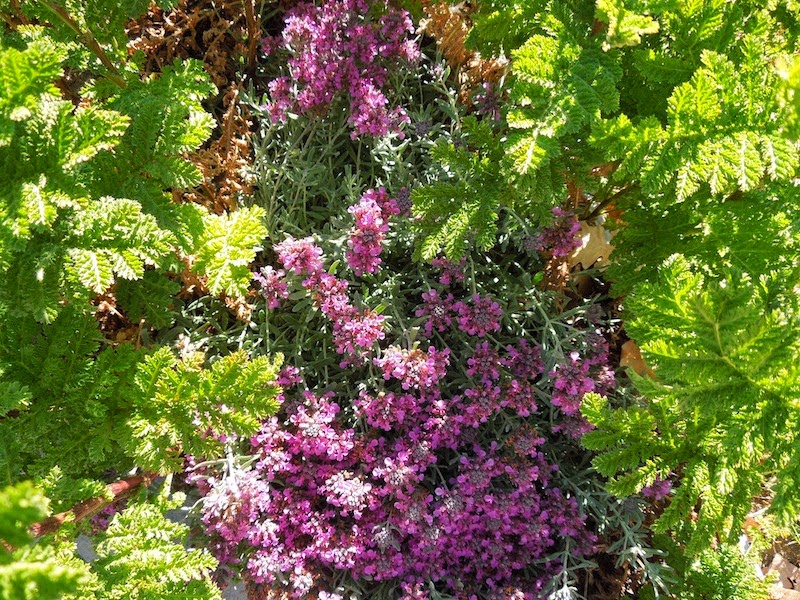

Fruity Teucrium Surrounded by Tansy
Another plant I bought new last year was the butterfly blue scabiosa you see here. It's also known as the pincushion flower. I would like to find more of them, and I may plant more from seed, but I think I want deeper and brighter colors if I add more plants. The small blue flowers you see on the right side are from the hyssop plant that shares a border with the scabiosa. 

This is Lamb's Ear. The mother plant came from my Templeton house, where I kept it in a pot because the gophers liked to eat it when it was in the ground. I have terrible gopher problems there, so I always keep the mother plant of anything new in a pot until I see if the gophers like it. Since Lamb's Ear really spreads to the point of being invasive and needs little care, I like to use it where I want to fill in bare ground to suppress the growth of weeds. I love the fuzzy gray Lamb's Ear leaves, and at this time of year the pale  flower stalks shoot up and fill with tiny lavender flowers. If you look carefully, you will see the bees love them. 


Last in this post I will show you my star jasmine which started blooming in May and which I expect to keep blooming all summer. It's attractive in moderation, but it tends to want to bury my border plants and I have to keep it well-trimmed. It does provide a nice background for contrast with the calendula, sage, pansies, godetias, lilies of the Nile, and poppies which I planted in front of it near the sidewalk.

The Flanders poppies also bloomed at the end of May as you saw in my last post. 

In my next post I will introduce the herbs that are currently blooming. Please stay tuned.

Sunday, May 25, 2014

How My Garden Has Progressed in Two Years Since 2012


First Ladybug I've Seen This Year on Catmint Plant
I'm back in the garden now.This morning was typical because it held a surprise for me -- this first ladybug I've seen this year. Something new is always happening in my garden, but I only know if I keep my eyes open for it.  I keep my camera handy to record anything I want to remember.

2012 and early 2013 were not good gardening years for me. I was caught up in freelance writing on Squidoo and HubPages, and I was also building up my Zazzle stores. I simply did not have time to do much gardening. I had inherited a house from my mother in Paso Robles, California in 2006 and in 2013 I decided I had to do something with the front yard there. My mother had done nothing with it in the almost ten years she lived there, and there were a few green shrubs and not much else.

The city of Paso Robles was getting stricter about water rationing in landscaping, so I knew if I were going to makeover the garden, I'd better use drought resistant plants.  I began my project just about this time in 2013. By then I had started writing for Bubblews, so I started a Garden Journal there. Every time I did something new to my garden or when changes such as a plant starting to bloom for the first time occurred,  I reported it, with photos, in a Garden Journal post. Unfortunately Bubblews removed almost all the photos from our posts in a big update to the site, and last year Bubblews quit. Except for my written back-ups and saved photos in a different place, all those visual journal posts are gone. From now on, I'll be keeping my gardening journal here again.


Is that garden now a showpiece? Definitely not. It will always be a work in progress and there will always be surprises. I write about it because I know there are many hobby gardeners like me who like to get ideas from ordinary gardeners like themselves and see what works and what doesn't in other gardens. I have learned new techniques and gotten many hints from those who have commented on my gardening posts at Bubblews. But now I want to bring some of those gardening posts back here to Blogger.

I have two garden areas -- one in Templeton, California, and one in Paso Robles. Both are very close to being in Sunset's Zone 16 (USDA Zone 9). We have hot dry summers, and sometimes have temperatures in the triple digits in May or October.  Our winters normally have lows ranging from 25 degrees down to 17 degrees F but a couple of the last twenty winters had temperatures down to 12 degrees F. This was cold enough to kill almost everything above ground on my gazanias. Fortunately, they regrew when temperatures warmed up again. Our summers are hot and dry in the daytime, but usually cool down when the sun sets.

Grapes and oak trees flourish here, so the Paso Robles and Templeton Gap areas are home to many vineyards. Olive trees also do well. Drought resistant public plantings include a lot of lavender, yarrow, artemisia, sages, rosemary. and santolina. I have grown all of these, and once established, they need little care. I find I can learn a lot about what to plant by seeing what the businesses use in their drought-resistant landscapes.

Flowers that work well for me year after year include irises, calendula, and daffodils. These are also plants that gophers tend to stay away from. Herbs also work well in my gardens and add summer color. The photo above shows the first ladybug I've seen all year nestled in my catmint, which grows in a pot in my flower bed closest to the house. It will be blooming soon. I also grow oregano, thyme, basil, cilantro, catmint, spearmint, sages, clary sage, mullein, monarda, borage,  hyssop, wormwood, rue, tansy, parsley.

So far my pansies I planted in winter and the petunias I planted last year are still blooming. That surprised me, since they usually don't last so long. My hyssop started to bloom about a week ago. So did my Chomley Farren carnations. They are a deep pink with lavender markings. I will try to show you the photos in future posts.

Spanish sage in bloom April 25, 2014, next to yellow pansies. Lamb's ear is in front of pansies. Godetia is just starting to bloom in foreground. Back right is rue next to a volunteer gopher plant. Behind all is jasmine.


My Spanish lavender blooms are dying down now after blooming last month. My Spanish sage is still going, though my jasmine, which is starting to spread and bloom is trying to bury it. I need to give that jasmine a haircut. My wild watermelon sage is still blooming red in my side bed, and my Fruity Teucrium, a germander, is producing purple flowers that look good in the middle of my spreading tansy. My small Windy City Rose is also in bloom, as is the light blue scabiosa I planted last year. I will show individual photos of these in future posts.  They are growing in other flower beds.

What is your favorite drought-resistant plant?
Related Posts Plugin for WordPress, Blogger...