 |
| How many can you find? Bees on Fruity Teucrium, © B. Radisavljevic |
Showing posts with label Fruity Teucrium. Show all posts
Showing posts with label Fruity Teucrium. Show all posts
Wednesday, May 25, 2016
Wordless Wednesday: Bees on Fruity Teucrium


Friday, May 13, 2016
Small Visitors to my Garden in Early May
Visiting Insects in May
Although we schedule our visits on a calendar, it's not so neat in the insect world. They appear by season rather than by date. So although I can say that these insects were all garden visitors during the first two weeks of May, some had been hanging around since April, and some, like the bees, visit me during the entire year. Let's look at them. My most welcome guests this month have been the ladybugs, who flew in to clean up my aphid problem.
 |
| Ladybugs Busy Mating and Eating Aphids, © B. Radisavljevic |
They have been a great help to me. In the photo above you can see the one on top eating one of the aphids. The two on the bottom of the flower are mating. You can see how the unwelcome aphids are sucking the life out of the calendula plants. In the middle of April I had four heavily infested calendula flowers and one infested wormwood plant. It took the ladybug air force a month to finish the job, but as of yesterday there are no more aphids and most of the ladybugs have moved on. Below is another calendula plant they cleaned up. Do you see all the ladybugs visible on just this one plant? I counted nine. How many can you count?
 |
| Ladybird Aphid Eating Crew on Calendula Plant, © B. Radisavljevic |
There are still a few ladybugs lurking in the rosemary and on other plants. I found the one below in the crotch of this clary sage plant. I'm hoping it's not about to be a meal for the spider that lives there. We will see it later.
 |
| Ladybird Hiding on Clary Sage Plant, © B. Radisavljevic |
Another insect currently in my garden is the spittlebug. Spittlebugs are small insects who cover their motionless nymphs, who hang out on the foliage of perennials, shrubs, annuals, and herbs, with this unsightly foam as they suck juices from the stems. According to Sunset, they do little damage and leave after about three weeks. If they really bother you, you can wash the foam off with a hose. They do make the plant look a bit ugly. Here they are "decorating" my rosemary.
 |
| Spittlebugs on Rosemary, © B. Radisavljevic |
The last insect, the one who visits almost every day, is the hard-working bee. Below you see it on fruity teucrium, a ground cover, which is blooming now. The bees love it. I couldn't fit them all into this one photo, and they kept flitting off to new blossoms while I was focusing.
 |
| Bees on Fruity Teucrium, © B. Radisavljevic |
Before we leave the insects, here's one more photo of a bee. This one is working on a lamb's ears flower. The lamb's ears started to bloom just a few days ago. This photo is just the right size to pin if you'd like to share it.
 |
| Busy Bee on Lamb's Ears, © B. Radisavljevic |
The Inconspicuous Crab Spider in Early May
This spider has visited many of my plants. I have seen her (and what I assume is her mate) on the calendula plants with the ladybugs and aphids, on the juniper bushes, and on the rosemary. It is very hard to see on this rosemary plant, even when I blow it up. It's not a large spider to start with, and it can take on the coloring of the plant it's on to blend in. Can you see it in the lower right corner below? I had to get into a very awkward position to get this photo at all.
 |
| Inconspicuous Crab Spider in Rosemary, © B. Radisavljevic |
One of these spiders seems to be living on my clary sage. It's much easier to see and photograph there. It usually scrunches up like this while waiting for prey to appear. I do have a video of two of these spiders interacting on a calendula plant, and once they start moving, they are fast. I think one may have been chasing the other. The one below is a female. The male is smaller. I saw a male on this plant a couple of days earlier. I don't see it now. I wonder if the female had him for dinner. To see how this spider mates, check the last photo on this blog post.
 |
| Inconspicuous Crab Spider on Clary Sage Leaf, © B. Radisavljevic |
Spiders & Other Arachnids

I love being able to understand which insects and spiders are visiting me. Here are some books which have been a great help in identifying and understanding them. The two books on the bottom right will appeal to children and are small enough to carry into the backyard for field use. The books on the bottom left have a format designed for teens and adults. All are illustrated and will help you identify garden visitors with six or eight legs. The short video at left above shows you some common spiders in action up close. Prime members can watch it for free. Try Amazon Prime 30-Day Free Trial

&
A Field Guide to Insects: America North of MexicoNational Audubon Society Field Guide to North American Insects and Spiders (National Audubon Society Field Guides (Paperback))Fandex Family Field Guides: BugsPeterson First Guide to Insects of North America
National Audubon Society Field Guide to North American Insects and Spiders (National Audubon Society Field Guides (Paperback))Fandex Family Field Guides: BugsPeterson First Guide to Insects of North America
&


Saturday, April 23, 2016
Tansy and Fruity Teucrium Can be Garden Friends
Are Tansy and Fruity Teucrium Compatible Garden Friends?
When I first planted tansy and fruity teucrium together in an oddly shaped corner of my flower bed nearest the street, I had four reasons for doing it.
 |
| Tansy and Teucrium First planted in 2013, © B. Radisavljevic |
- They would fit there.
- They could live in poor soil and required little water
- They would fill in the space as they grew.
- Their flower colors would be complementary to each other
I wanted to fill in that one small triangle tip. I also had heard that tansy was good for repelling ants, so I thought it might be helpful to have some on hand. (It turned out not to repel my ants.) The teucrium would bloom first with its light purple flowers. The tansy would make its big splash of bright yellow in summer and overshadow the teucrium.
The plants were tiny, as you can see above, when I planted them in June, 2013. I knew tansy could be invasive, and since I was trying to fill space with something that would smother the weeds, I thought its tendency to take over would serve that purpose. I like to pick my weeds. My plan would have worked better had I realized when I planted that I should have planted these tiny herbs farther apart.
By August 25, 2015, that triangular corner looked like this. The teucrium swallowed the tiny tansy at the very end, but it still peeks through when it finds a way. The tansy does spread, but it also dies back after it blooms in July leaving these empty spaces. That doesn't stop it from trying to invade the teucrium, though.
 |
| Tansy and Teucrium by August, 2015, © B. Radisavljevic |
Things to Know about Fruity Teucrium and Tansy
The fruity teucrium is also called fruity germander. It flowers bountifully in spring and fall, but not so much in summer while the tansy is in full bloom. It is dearly loved by bees and butterflies. After the flowers bloom, they turn brown, as you can see above.
Tansy leaves also turn brown in the summer heat, so it's recommended that when that happens one should cut them them to the ground. According to an article I just read about tansy, if this is done early enough, new foliage may grow out and there may even be a new round of blooming. I'll try to remember that this year. For comparison, this is how my little triangle looked on July, 9, 2014.
 |
| Tansy in July, 2015, © B. Radisavljevic |
Just so you can get a closer look at the fruity teucrium (or fruity germander), I will show you these photos taken in August, 2015. Here's the whole plant, or at least most of it. These two photos are also part of one of the related articles below.
 |
| Teucrium by August, 2015, © B. Radisavljevic |
Here is a closeup of the fruity teucrium flower.
 |
| Close-up of Teucrium Flower, August, 2015, © B. Radisavljevic |
I took the photo below today, April 23, 2016. The tansy is reemerging and invading the teucrium. In fall I will probably do some root divisions and move some of these plants to where nothing else but weeds and gazanias will grow. I may have made a mistake in believing tansy and teucrium can be garden friends, but I will leave that for you to decide.
I share my garden experiments in case the information may help others know what to expect if they do what I have done. Like most home gardeners, I have both successes and failures. I hope something I share in these posts will help you.
Note; Please keep in mind that tansy can be toxic to pets and people. Use it with care.
If you this post useful, please share it. The sharing buttons are just above the comment box at the end of the post. The photo below is especially designed for pinning.
 |
| Tansy and Teucrium Together in April, 2016, © B. Radisavljevic |
I share my garden experiments in case the information may help others know what to expect if they do what I have done. Like most home gardeners, I have both successes and failures. I hope something I share in these posts will help you.
Note; Please keep in mind that tansy can be toxic to pets and people. Use it with care.
If you this post useful, please share it. The sharing buttons are just above the comment box at the end of the post. The photo below is especially designed for pinning.

This is my twentieth post for the 2016 AtoZchallenge, a Blogging Challenge for the month of April, 2016. My theme is plants, since this is a gardening blog. Here are links to the other posts if you missed them.
A is for Apple Blossoms
B is for Bottlebrush
C is for Carnations
D is for Daisy
E is for Elderberry
F is for Flowers
G is for Gazania
Hollyhocks are Edible
Irises Are Garden Survivors
Jupiter's Beard: A Mystery Finally Solved
Kale for Lunch
Lion's Tail - A Perennial Summer Burst of Orange
Miner's Lettuce is Tasty and Free"Naked Ladies" Bloom in August
Oleander through the Year
Plant Pests and their Predators: Aphids and Ladybugs
Quince Fruit from Blossom to Table
Roses Are Not Just Red


Wednesday, May 28, 2014
What Blooms in My Paso Robles Garden at the End of May: Flowers

May is a colorful month in the garden. I have decided to start keeping a record of what blooms each month so that I can predict what my garden will look like every month of the year. My goal is to have some garden color through all seasons. I took this photo on May 27, 2014. Not all colors come from flowers.
In the foreground you can see the mums which started to bloom a couple of weeks ago. If you look back a bit and to the right, you will see a pot of tricolor sage that adds a touch of purple to the mix. Next to it is a hyssop plant with its tiny blue flowers to feed the bees. The yellow is calendula, and that blooms almost all year and reseeds itself. As you can see, I like to mix plants up in my garden, so it has a somewhat wild look. Now we will take a closer look at individual flowers.
First are the chrysanthemums. I usually associate them with autumn, but these are also blooming for me in spring. I just read that I can take cuttings from these up until the end of the month. I might try it to see if I can make more plants by fall. I have two regular size mums and two miniature ones of different colors spread throughout this garden now.


I also planted some petunias in the fall. Most have faded and died, but this pink one still remains. These are technically perennials, but people usually grow them as annuals. I may not replace them, since they don't do well without more water than I want to give them since water for landscaping is rationed until the end of summer. This petunia is taking cover under an iris leaf.

Carnations have always had a special place in my gardens because my mother loved them. I still have some carnation plants that came from root divisions of one of her plants. I first started one in our Newbury Park home in Ventura County, and when we moved, I brought it here. I have two babies from that mother plant in my Paso Robles garden now. They produce very light pink flowers. You can see one of those plants below. Although I have been deadheading them, they appear not to be producing many new flowers now, so I think their season may be coming to an end. They have been covered with flowers for the past two months. Now each plant only has a flower or two left.

As you can see, in order to keep the flowers from landing on the ground, I've propped them up on some borage plants -- also in bloom with tiny star-like blue flowers. On the far right you can see a single yellow calendula.

In this next photo I have also mixed the flowers with herbs. I wanted some drought resistant plants in a side bed in a corner between two sidewalks. It has poor soil and doesn't get much water. I decided to plant a Fruity Teucrium there, with a tansy plant on either side of it. I expected the tansy to contrast with the purple flowers of the Teucrium, since the tansy will bloom yellow when it finally blooms. I know tansy spreads, but I didn't expect it to be so much taller than the Teucrium to the extent that it almost blocks it from the light. I will have to cut it back if the Teucrium is to survive.
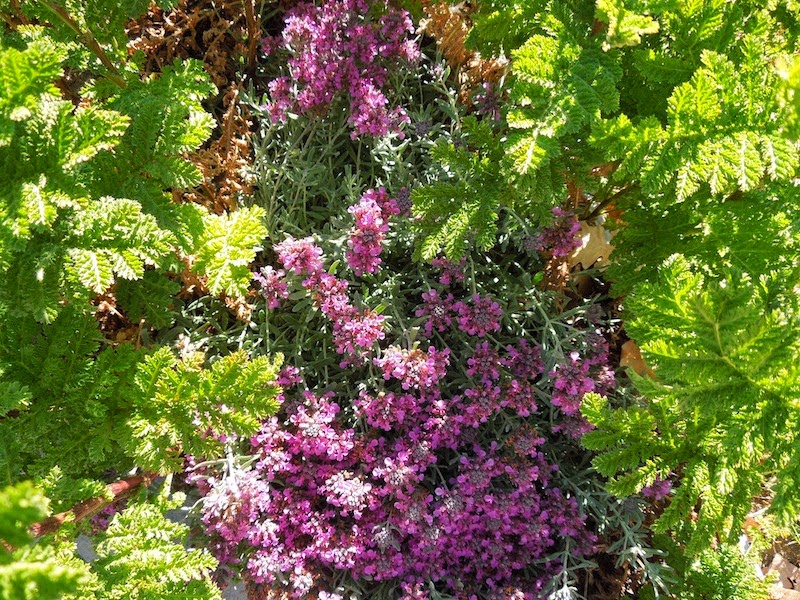 |
Fruity Teucrium Surrounded by Tansy
Another plant I bought new last year was the butterfly blue scabiosa you see here. It's also known as the pincushion flower. I would like to find more of them, and I may plant more from seed, but I think I want deeper and brighter colors if I add more plants. The small blue flowers you see on the right side are from the hyssop plant that shares a border with the scabiosa.
|
 This is Lamb's Ear. The mother plant came from my Templeton house, where I kept it in a pot because the gophers liked to eat it when it was in the ground. I have terrible gopher problems there, so I always keep the mother plant of anything new in a pot until I see if the gophers like it. Since Lamb's Ear really spreads to the point of being invasive and needs little care, I like to use it where I want to fill in bare ground to suppress the growth of weeds. I love the fuzzy gray Lamb's Ear leaves, and at this time of year the pale flower stalks shoot up and fill with tiny lavender flowers. If you look carefully, you will see the bees love them.
The Flanders poppies also bloomed at the end of May as you saw in my last post.
In my next post I will introduce the herbs that are currently blooming. Please stay tuned.
Subscribe to:
Posts (Atom)
